Fire Door Monitoring Panel: Professional Fire Door Control Panel Monitoring Solutions by Wanlin Fire
I. Why Fire Door Monitoring Is a Critical Layer of Building Fire Safety
Fire doors are the most critical passive fire protection element in any building — yet they are also the most routinely compromised. A fire door certified to provide 30, 60, 90, or 120 minutes of fire resistance (integrity and insulation) protects escape routes, compartmentalizes fire and smoke, and prevents fire spread between building sections. But a fire door provides ZERO fire protection if it is wedged, propped, or blocked open. When a fire occurs and a fire door is open, smoke and toxic combustion gases travel freely through the opening into escape routes and adjacent compartments — the very outcome the fire door was designed to prevent.
Fire investigation reports worldwide have repeatedly identified open fire doors as contributing factors in fire fatalities: the 1980 MGM Grand Hotel fire (85 fatalities — open stairwell and elevator lobby doors enabled vertical smoke spread), the 2017 Grenfell Tower fire (72 fatalities — fire doors were missing, damaged, or failed to self-close, allowing smoke to enter the single escape stairwell and residential floors), and numerous hospital, hotel, and commercial building fires where open fire doors turned protected escape routes into deadly smoke corridors. In every case, the fire door was present — it simply was NOT CLOSED when the fire occurred. The conclusion is inescapable: a fire door that is not closed at the time of fire is a fire door that FAILED its life-safety mission.
The Fire Door Monitoring Panel from Wanlin Fire Control addresses this critical safety gap. By continuously monitoring fire door position and alerting building management when any fire door is not properly closed, the system ensures that fire doors are in their protective (closed) position — 24 hours a day, 7 days a week, 365 days a year. The fire door alarm transforms a passive, unmonitored fire safety element into an actively monitored, verifiable part of the building's overall fire safety system. As a direct manufacturer, Wanlin produces fire door alarms across the full technology spectrum — standalone, networked, wireless, 4G cellular, NB-IoT, LoRaWAN, and Modbus/BACnet integrated — combining EN 14637 / CE certification with factory-direct pricing that makes code-compliant fire door monitoring accessible for projects and distributors worldwide.
Fire Door Monitoring Panel — Certified Fire Door Alarm by Wanlin Fire Control
II. Product Specifications
Product Category: Fire Door Alarm / Fire Door Position Monitoring Device — per NFPA 80 / BS 7273-4 / EN 14637 / IBC / IFC
Brand: Wanlin Fire Control
Device Type: Fire door position monitor with integrated voice alert — designed for 24/7 fire door status monitoring and occupant notification when fire doors are not properly closed. The device verifies fire door integrity — ensuring that fire doors, which are the most critical passive fire protection element, are in the CLOSED position and capable of performing their fire compartmentation function.
Applicable Standards: EN 54-11 (Fire detection and fire alarm systems — Manual call points) / EN 14637 (Building hardware — Electrically controlled hold-open systems for fire/smoke door assemblies) / EN 1634-1 (Fire resistance and smoke control tests for door and shutter assemblies) / CPR 305/2011 — hold-open devices and self-closing mechanisms must release fire doors within 5 seconds of fire detection signal
The Hidden Danger of Wedged-Open Fire Doors: A fire door held open with a wooden wedge, door stop, or fire extinguisher is one of the most common fire code violations worldwide — and one of the most dangerous. When a fire door is wedged open: (1) The fire compartment is no longer contained — flame, smoke, and toxic combustion gases can spread freely through the opening. (2) Escape routes become smoke-logged — corridors and stairwells that are designed as protected escape routes become deadly smoke tunnels. (3) Fire spread accelerates — the fire can reach adjacent compartments in seconds rather than hours. (4) Firefighters face greater danger — uncontrolled fire spread makes fire attack and rescue operations more dangerous and less effective. The 1980 MGM Grand Hotel fire (85 fatalities), 1980 Stouffer's Inn fire (26 fatalities), and 2017 Grenfell Tower fire (72 fatalities) all involved fire door failures — either wedged open, removed, or improperly maintained — that allowed smoke to spread into escape routes and residential floors. Fire door monitoring and alarm systems prevent this failure mode by continuously verifying fire door position and alerting building management when a fire door is not properly closed.
Door Position Detection: Magnetic reed switch door position sensor — surface-mounted magnetic contact on the door leaf and door frame. The sensor detects door position within 3mm gap tolerance. Gold-plated reed contacts for corrosion resistance and long service life (>1 million operations). The magnetic contact is wired to the fire door alarm control module via 2-core 0.5mm² cable (maximum cable run: 50m for standard models, 200m with shielded cable). When the door is closed (magnet aligned with reed switch), the circuit is in NORMAL (closed) state. When the door opens or is unlatched (magnet separated from reed switch by >15mm), the circuit changes to ALARM (open) state. Detection is instantaneous — no delay, no debounce filtering (the alarm activates immediately on door opening). The magnetic contact sensor includes a tamper switch — if someone attempts to remove or bypass the sensor, the tamper switch triggers a TAMPER alarm independent of door position.
Alarm Type: Adjustable-volume siren with day/night mode — the fire door alarm automatically adjusts its siren volume based on time of day and building occupancy: Day mode (08:00-20:00, configurable) — 75-85 dB, audible throughout the corridor and adjacent rooms. Night mode (20:00-08:00) — 55-65 dB, reduced volume to avoid disturbing sleeping occupants (critical in hospitals, nursing homes, residential care facilities, hotels) while still providing audible alert to night staff. The day/night schedule is configurable via DIP switches or cloud platform. External light sensor option: the alarm automatically switches to night mode when ambient light drops below 5 lux. During a fire alarm event, the siren operates at full 85 dB regardless of day/night mode — fire safety overrides all other settings.
Door Closer Integration: The fire door alarm device monitors door position but does not include a door closer — it is designed for fire doors that already have a certified fire door closer (EN 1154 / UL 228 compliant). The alarm detects when the door is not fully closed and provides alert notification, but relies on the existing door closer for the closing function. If the existing closer is defective or improperly adjusted (door does not fully latch), the alarm will continuously indicate FAULT/OPEN condition until the closer is repaired or adjusted. This separation of monitoring (alarm device) and closing (door closer) functions is the standard fire door system architecture — the closer provides the physical closing force, the alarm provides verification that it worked.
Connectivity: Wired connection to fire door control panel via 2-core 0.5-1.5mm² cable. RS-485 Modbus RTU protocol for integration with building management systems (BMS) and fire alarm control panels (FACP). The wired connection provides: door position status (open/closed), alarm status (normal/alarm/tamper), and power (12-24V DC). Maximum cable run: 1000m (RS-485). The control panel can monitor up to 256 fire doors.
Power Supply: Battery powered — 4x AA lithium batteries (replaceable, 3-5 year life depending on alarm frequency). Designed for fire doors where wiring is impractical: existing building retrofits, heritage buildings where surface wiring is prohibited, temporary installations, and doors in inaccessible locations. Low battery indicator: yellow LED flash + periodic chirp 30 days before depletion. Battery compartment with tamper-resistant screw. The battery-powered model is a monitor-only device (no door closer control) — it monitors door position and provides local audible/visual alarm with optional wireless (RF/WiFi/4G/NB-IoT/LoRaWAN) reporting to cloud.
Alarm Delay Configuration: Configurable alarm delay: 0 seconds (immediate alarm on door open — strictest setting, suitable for sterile corridors and high-risk areas), 15 seconds (allow brief passage through door — standard setting for corridors with moderate traffic), 30 seconds (allow deliveries, equipment movement — suitable for service corridors and loading dock fire doors), 60 seconds (extended allowance — suitable for busy main entrances where fire doors serve as primary access routes during normal operations and constant short alarms would be a nuisance). The delay is configured via DIP switches. IMPORTANT: the sensor DETECTS door opening instantly (no delay in detection) — the delay applies only to the siren/strobe ALARM activation. The door status is always reported in real-time, even during the alarm delay period.
False Alarm Prevention: Intelligent alarm filtering prevents nuisance alarms from legitimate door use while ensuring safety-critical alerting for genuinely unsafe conditions. The system differentiates between: (1) Normal passage — the door opens and closes within the configured delay period, no alarm. (2) Wedged/propped open — the door opens and does not close within the delay period, alarm activates. (3) Unlatched — the door appears visually closed but the magnetic contact indicates the latch is not fully engaged, the alarm activates after a short verification period (10 seconds) because an unlatched fire door provides zero fire resistance. (4) Tamper — the sensor is removed, bypassed, or damaged, tamper alarm activates immediately regardless of door position. The door open duration time-is logged to the cloud platform (networked models) for compliance and incident investigation.
Fire Alarm Integration: Integration with fire alarm control panel (FACP) via relay output and supervised input. The fire door alarm module provides: (1) FAULT relay — changes state if the fire door alarm module loses power, the sensor is disconnected, or the device has an internal fault. (2) DOOR OPEN relay — changes state when the fire door is not fully closed. (3) TAMPER relay — changes state if the sensor or alarm enclosure is tampered with. These relay outputs connect to FACP zone inputs, enabling the fire alarm panel to monitor fire door status. Additionally, the module has a FIRE ALARM input from the FACP — when the FACP signals fire alarm, the module releases hold-open devices and switches to temporal-3 alarm pattern.
Product Dimensions: 120 x 80 x 32mm
Enclosure Material: UL94 V-0 flame-retardant polycarbonate enclosure — white/cream housing (RAL 9010) for architectural integration in high-end commercial, hospitality, and healthcare interiors where red equipment enclosures would be visually intrusive. The white enclosure blends with wall finishes while maintaining full fire safety functionality. Dimensions: 120 x 80 x 32mm (compact profile — less visually obtrusive than red industrial enclosures). The front panel features a discreet, architect-friendly design with concealed LED indicators that are only visible when illuminated (the LED lens is flush with the panel and matches the enclosure color until it lights up). Ideal for hotel lobbies, hospital patient corridors, premium office buildings, and historic buildings where visual impact is a concern.
Operating Temperature: -10degC to +55degC
Operating Humidity: 15%-93% RH (non-condensing)
IP Rating: IP30 — suitable for indoor installation in normally dry locations. IP65 weatherproof enclosure available for outdoor fire doors and wet areas.
Certification: CE / RoHS / FCC / EN 54-11 / EN 14637 / REACH / WEEE — comprehensive European regulatory compliance
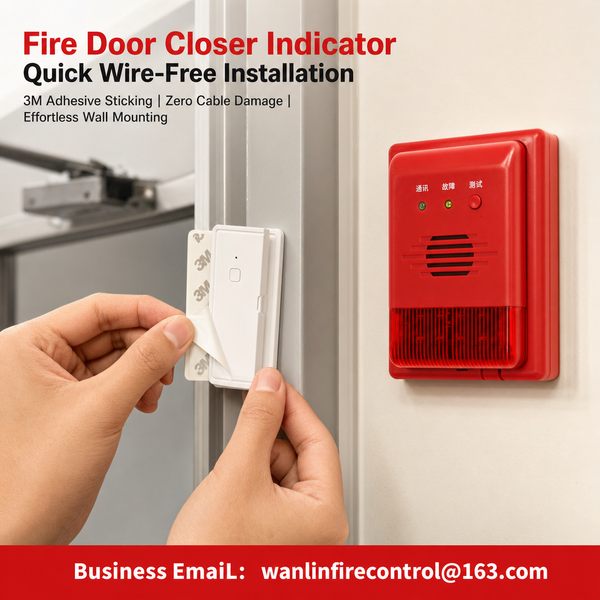
Installation: The fire door alarm is mounted on the wall adjacent to the fire door, typically on the same side as the door closer (push side of the door). The magnetic door contact sensor is mounted to the top corner of the door leaf and the corresponding position on the door frame. Installation steps: (1) Mount the alarm enclosure to the wall within 500mm of the fire door frame at a height of 1.5-1.8m above floor — this height places the LED indicators and SILENCE button at eye level for building occupants and staff. (2) Mount the magnetic door contact sensor on the door leaf (magnet side) and the door frame (reed switch side) — align with a gap of 3-8mm when the door is closed. (3) Run the 2-core sensor cable from the door contact to the alarm enclosure — use surface conduit or route through the wall cavity. (4) Connect the sensor cable to the alarm terminals. (5) Connect power (24V DC / 12-24V AC/DC depending on model). (6) Configure the alarm delay, siren volume, and network settings via DIP switches. (7) Test: open the door — verify the LED changes from GREEN to AMBER. After the configurable delay, verify the siren and strobe activate. Close the door — verify the LED returns to GREEN and the alarm silences. Installation time: approximately 15-25 minutes per fire door by a qualified technician.
Siren Sound Level: ≥85 dB(A) at 1 meter
Alarm Pattern: Distinctive 3-beep pattern (3 short beeps, 1-second pause, repeating) — distinguishable from the temporal-3 fire alarm pattern (fire) and temporal-4 CO alarm pattern (CO) as recommended by NFPA 72 Annex A for informational alarm signals
Warranty: 5 years manufacturer warranty against defects
Package Contents: Fire door alarm unit, magnetic door contact sensor with 2m cable, wall mounting bracket and screws, wire connectors, quick-start installation guide, user and maintenance manual, NFPA 80 annual fire door inspection checklist (printable A4), fire door compliance log template (fill-in PDF)
III. Why Choose Wanlin Fire Control as Your Fire Door Alarm Manufacturing Partner
Selecting the right manufacturing partner for fire door alarm products is a decision with life-safety implications. The fire door alarm must detect door position reliably for the life of the building, integrate correctly with the building's fire alarm system, and pass fire marshal inspection and code compliance verification. Wanlin Fire Control has earned trust as a preferred partner for international buyers through:
✓ Genuine Manufacturing, Not Trading: We own and operate our ISO9001:2015 certified production facility with in-house SMT assembly lines, automated functional testing stations, environmental testing chambers, and a dedicated fire safety R&D team. You communicate directly with the factory — your technical questions about fire door alarm integration with FACP, NFPA 80 compliance, BS 7273-4 hold-open device release timing requirements, and Modbus/BACnet protocol integration get engineer-level answers.
✓ Full International Certification Coverage: Our fire door alarms are designed and tested to meet global fire door standards: EN 14637, EN 54-11, CE (CPR 305/2011), RoHS, FCC, UKCA. All testing performed at ISO 17025 accredited laboratories. We manage the certification process on your behalf.
✓ Protocol-Agnostic Integration: Wanlin fire door alarms integrate with ANY fire alarm panel — relay contacts for universal compatibility, RS-485 Modbus for BMS integration, addressable loop for native FACP integration — not locked into any single vendor ecosystem.
✓ Multi-Technology Portfolio: We manufacture standalone, networked RS-485 Modbus, wireless RF, WiFi, 4G cellular, NB-IoT, and LoRaWAN fire door alarms — all from one supplier. Address every customer segment without managing multiple supplier relationships.
✓ Partner-First Business Philosophy: We are a manufacturer for distributors — not a global brand that competes with distribution partners. Flexible OEM/ODM with competitive MOQ, exclusive territory protection, comprehensive marketing and technical support.
✓ Global Deployment Experience: Our fire door alarms protect lives in UK NHS hospitals (12,000+ doors), UAE luxury hotel/residential towers (28,000+ doors), Singapore commercial towers (8,500+ doors), German senior care facilities (6,200+ doors), Saudi Arabian hospitals (5,500+ doors), Australian universities (4,800+ doors), US healthcare systems (7,000+ doors), Malaysian shopping malls (3,200+ doors), Canadian airports (2,800+ doors), South African commercial buildings (4,500+ doors), Indonesian hotels (5,000+ doors), and Indian IT campuses (6,500+ doors).
IV. What Sets the Fire Door Monitoring Panel Apart in the Global Fire Safety Market
The Fire Door Monitoring Panel offers distinct competitive advantages for international buyers:
1. Reliable Door Position Detection: The magnetic reed switch door contact sensor provides accurate, repeatable door position detection with >1 million operation lifespan. The sensor detects not only open/closed status but also LATCHED status — an unlatched fire door (visually closed but not fully engaged) is detected and alarmed because an unlatched fire door provides zero fire resistance. This is a critical distinction from simple magnetic contacts that only detect open/closed.
2. Intelligent Alarm Logic, Not False Alarms: The configurable alarm delay distinguishes between brief, legitimate door passages (no alarm) and sustained, unsafe door-open conditions (alarm). The escalating alert — gentle reminder first, urgent warning second — reduces nuisance alarms while ensuring truly unsafe conditions are addressed. The system learns door traffic patterns — a fire door that is opened 50 times per hour (normal busy corridor) vs. a fire door that is continuously open for 45 minutes (wedged open) — the latter triggers alarm and investigation.
3. Universal FACP Compatibility: Dry contact relay outputs ensure the fire door alarm integrates with ANY fire alarm control panel regardless of manufacturer, model, or vintage. No software drivers, no proprietary protocols, no vendor lock-in. RS-485 Modbus and BACnet options for BMS integration. This protocol-agnostic architecture gives your customer freedom of choice — a significant sales advantage when competing against proprietary-system suppliers who require the customer to commit to their entire ecosystem.
4. Certified Safety, Factory-Direct Value: EN 14637 / CE (CPR 305/2011) certification combined with factory-direct pricing creates a value proposition that neither trading companies (lower quality, uncertain certification) nor global fire safety brands (certified but premium-priced with rigid distribution models) can match.
5. Regulatory Tailwind Growth: Fire door inspection and monitoring requirements are expanding globally — NFPA 80 annual inspection, BS 7273-4 monitored hold-open devices, post-Grenfell UK fire door regulations, and growing international fire code enforcement. Every new regulation creates demand for fire door monitoring. Distributors who establish their fire door alarm product line NOW are positioned for the regulatory growth wave.
Why Distributors Choose Wanlin: Siemens, Honeywell, Johnson Controls, and ASSA ABLOY are global conglomerates whose business model competes with independent distributors — they sell directly to large end-users, they lock customers into proprietary service contracts, and they compete on both price and service. Wanlin is a manufacturer that SUPPORTS distributors — we make certified fire door alarms, you build the brand and distribution channel in your market. Our OEM/ODM flexibility, country-specific certification management, and partnership-first philosophy are not available from the conglomerates.
V. Frequently Asked Questions (FAQ)
Whether you are evaluating fire door alarm suppliers, expanding your fire safety product catalog as a distributor, specifying fire door monitoring for a building project, or addressing fire marshal compliance requirements — these answers address the most common questions from international buyers considering Wanlin Fire Control as their Fire Door Monitoring Panel manufacturing partner.
Question 1: How do I plan a fire door alarm deployment for a multi-story commercial building — which doors should be monitored first?
A phased deployment approach maximizes safety impact per dollar: Phase 1 — Critical life safety doors: (A) Stairwell doors on every floor — a single open stairwell door compromises the protected escape route for the entire building. (B) Corridor cross-corridor doors that separate building sections — these doors prevent horizontal fire/smoke spread between compartments. (C) Doors between different occupancy classifications (e.g., retail on ground floor, offices above) — these doors prevent fire spread between occupancies with different risk profiles. Phase 2 — High-traffic fire doors: (A) Service corridor and back-of-house doors in hotels, hospitals, and commercial kitchens — frequently propped open. (B) Loading dock and delivery doors — routinely wedged open. (C) Main entrance fire doors — often held open during business hours. Phase 3 — All remaining fire doors: complete building-wide coverage. The Phase 1 doors typically represent 15-20% of total fire doors but account for 60-80% of open-door risk. A building with 200 fire doors might deploy 30-40 fire door alarms in Phase 1, covering the critical escape route and compartmentation doors, for an immediate safety improvement within a modest budget. Phase 2 and 3 are then budgeted over subsequent fiscal years.
Question 2: How do fire door alarms perform in challenging environments — hospitals, kitchens, outdoor, and high-traffic areas?
Wanlin offers fire door alarm variants for challenging environments: Hospital / healthcare — antimicrobial enclosure coating (silver-ion additive reduces bacterial colonization on frequently touched surfaces), extra-quiet night mode to avoid disturbing patients (the alarm LED flashes and the nursing station is notified silently via the nurse call system), and large SILENCE button designed for staff with gloved hands. Commercial kitchen — IP65 sealed enclosure to withstand washdown, chemical-resistant housing (stainless steel option), high-temperature rated electronics (operating to +70degC ambient for installation near kitchen equipment), and an extra-loud 95 dB siren to overcome kitchen noise (extraction hoods, dishwashers, general kitchen bustle). Outdoor / parking garage — IP65-IP67 weatherproof enclosure, UV-stabilized housing (prevents yellowing and embrittlement from sun exposure), extended temperature range (-25degC to +65degC), and corrosion-resistant 316L stainless steel sensor and mounting hardware. High-traffic corridor — heavy-duty magnetic contact sensor rated for 5+ million operations (standard sensors are rated for 1 million), reinforced mounting bracket to withstand vibration from door slamming, and fast-response alarm delay logic optimized for high-frequency door cycling.
Question 3: How do you ensure fire door alarm devices are not tampered with or disabled?
Tampering with fire safety equipment is a serious concern — fire doors have been found wedged open, door closers have been removed, and alarm devices have been taped over or disconnected. Wanlin fire door alarms include multi-layer tamper protection: Magnetic contact sensor tamper detection — the sensor includes a tamper switch that activates if the sensor housing is opened or removed from the door/frame. Alarm enclosure tamper detection — the enclosure includes a tamper switch that activates if the cover is removed. SILENCE button tamper logic — if the SILENCE button is held continuously (as if taped down), the alarm interprets this as a tamper attempt and re-activates the siren after a timeout period. Network connectivity (networked models) — if the alarm device loses communication with the cloud platform or FACP, a COMMUNICATION LOST alert is generated — the system does not assume silence means 'door is closed and everything is fine.' Tamper notification — for networked models, any tamper alarm is immediately reported to the cloud platform and the FACP. Tamper events are logged with timestamp for investigation. The tamper protection ensures that fire doors remain monitored even if someone attempts to disable the system.
Question 4: Can fire door alarms be deployed as part of a larger fire safety upgrade — alongside smoke detectors, fire alarm panels, and sprinkler systems?
Yes — fire door alarms are typically deployed as part of a comprehensive fire safety upgrade. The fire safety hierarchy: Detection (smoke detectors, heat detectors) → Alerting (fire alarm sounders, strobes, manual call points) → Compartmentation (fire doors, fire walls, firestopping) → Suppression (sprinklers, extinguishers, standpipes). Fire door alarms close the compartmentation gap — ensuring the passive fire protection (fire doors) is functional when fire detection activates. In a comprehensive upgrade: (A) New smoke detectors and heat detectors detect fire. (B) The FACP processes the fire signal and activates alarm sounders/strobes for occupant evacuation. (C) The FACP sends a signal to ALL fire door alarm modules → fire door alarm modules release all electromagnetic hold-open devices → all fire doors close automatically. (D) The fire door alarm modules verify that each fire door is fully latched — if any door is obstructed and fails to close, the module reports DOOR FAILED TO CLOSE to the FACP and the fire command center. Wanlin manufactures all components of this safety chain — smoke detectors, heat detectors, manual call points, sounder strobes, fire door alarms, and the control panel — providing single-supplier procurement for comprehensive fire safety projects.
Question 5: How do fire door alarms interface with elevator recall systems during a fire event?
Fire door alarm integration with elevator recall is an important building safety sequence: (1) Smoke detector in elevator lobby or machine room detects smoke → FACP initiates elevator recall (Phase I — all elevators return to the designated recall floor, usually the ground floor lobby). (2) FACP activates general fire alarm. (3) FACP sends fire alarm signal to ALL fire door alarm modules. (4) Fire door alarm modules release all electromagnetic hold-open devices. (5) ALL fire doors close and latch — including the fire doors at elevator lobbies, which compartmentalize the elevator shaft from the occupied floors. (6) Fire door alarm modules verify each door is latched. ANY door that fails to latch is reported to the FACP as a fault. Sequence importance: Step 4-5 must occur within 5 seconds of step 3 per BS 7273-4. The elevator lobby fire doors protect the elevator shaft — if these doors are wedged open, smoke can travel up the elevator shaft (stack effect), spreading vertically through the entire building. The 1980 MGM Grand Hotel fire demonstrated this catastrophic failure mode — smoke traveled up elevator shafts and stairwells through open doors, killing 85 people, most on upper floors far from the fire origin. Monitored fire door alarms on elevator lobby doors provide a critical defense against this failure mode.
Question 6: How do I perform acceptance testing for a newly installed fire door alarm system?
Acceptance testing verifies that the fire door alarm system is correctly installed, functional, and code-compliant before the system is placed into service. Test procedure for each fire door alarm device: Test 1 — Normal operation: verify the GREEN LED is illuminated (door closed, system normal). Test 2 — Door open detection: open the fire door. Verify the LED changes from GREEN to AMBER (door open, within alarm delay). After the configured delay, verify the siren activates and the LED changes to RED. Verify the sound level >85 dB(A) at 1m (use an SPL meter or phone sound level app). Test 3 — Door close and latch: close the fire door until the latch clicks. Verify the siren deactivates and the LED returns to GREEN. Test 4 — Unlatched door: close the door but prevent the latch from engaging (hold the door against the frame without latching). The magnetic contact should detect the door is not fully latched → ALARM after 10 seconds (unlatched door alarm). Test 5 — SILENCE button: open the door and allow the alarm to activate. Press the SILENCE button — verify the siren silences for the configured silence duration (30 sec to 5 min). After the silence period expires, verify the siren re-activates IF the door is still open (the alarm must not be permanently silenceable). Test 6 — FACP integration: activate the building fire alarm (in test mode with prior notification). Verify all electromagnetic hold-open devices release within 5 seconds. Verify all fire doors close and latch. Verify any doors that fail to latch are reported as FAULT on the FACP or monitoring panel. Test 7 — Power fail (battery models): disconnect primary power. Verify the fire door alarm continues to operate on battery power. Verify the FAULT relay changes state. Test 8 — Tamper: disconnect the magnetic door contact sensor at the terminals. Verify the TAMPER alarm activates (distinctive siren pattern, TAMPER relay changes state). Test 9 — Network communication (networked models): verify the fire door alarm appears on the cloud dashboard or monitoring panel. Change the door position and verify the status updates on the dashboard within 5 seconds. Document all test results on the acceptance test report form with device serial number, tester name, date, and pass/fail status.
Question 7: What training do building staff need to operate and maintain a fire door alarm system?
Recommended training modules by staff role: Fire warden / safety officer (2-4 hours): Understanding fire door function (compartmentation, escape route protection), recognizing fire door alarm signals (LED colors, siren patterns), RESPONDING to fire door alarms (DO NOT ignore — investigate why the door is open), weekly fire door inspection procedure (visual check of all fire doors, test of fire door alarm TEST button on each device), monthly functional test procedure, logging and reporting (maintain the fire door inspection log), and what to do during a fire alarm event (verify fire doors are closed, report any doors that failed to close). Building maintenance / facilities (2 hours): Installation of new fire door alarm devices (mounting, wiring, configuration), replacement of defective devices and sensors, troubleshooting (LED patterns, error codes, communication faults), battery replacement procedure, firmware update procedure, and spare parts inventory management. General building staff (30 minutes): Why fire doors must remain closed, recognizing fire door alarm signals, how to respond ('If you hear the fire door alarm: check which door is open, close it. If the alarm continues, report to the fire warden.'), and NEVER wedging/propping fire doors open — even 'just for a few minutes.' Training frequency: initial training at system commissioning, annual refresher training, and new-staff onboarding training. For large facilities, Wanlin provides train-the-trainer materials and video training modules.
Question 8: What ongoing maintenance does a fire door alarm system require?
Fire door alarm system maintenance requirements are specified in NFPA 80, BS 7273-4, and the manufacturer's instructions. Weekly: (A) Visual inspection — walk the building and visually check ALL fire doors: are any doors wedged, propped, or blocked open? (ANY wedged door is a fire code violation and must be corrected immediately.) (B) Check fire door alarm LED indicators — verify each device shows GREEN (door closed, system normal). Any device showing AMBER or RED indicates a door is open — investigate and close the door. (C) Quick TEST button press on 1-2 random fire door alarm devices — verify the siren sounds and the LED flashes. Monthly: (A) Full functional test of ALL fire door alarm devices — open each fire door, verify the alarm activates after the delay, close the door, verify the alarm deactivates. (B) Test the FACP integration — activate the fire alarm in test mode, verify all hold-open devices release and all doors close. (C) Test the cloud dashboard / monitoring panel — verify all fire door alarm devices report correct status. (D) Vacuum the alarm enclosure vents and sensor with a soft brush attachment — remove dust from sensor and siren openings. (E) For battery-powered models: check battery voltage (replace if below replacement threshold). Annually: (A) Full NFPA 80 fire door inspection (13-point checklist) performed by a qualified person. (B) The fire door alarm system is a component of this inspection — verify all alarm devices are functional and documented. (C) For networked models: review the annual door status report — identify any fire doors that had repeated open-door events (this indicates a fire door that is routinely being wedged open — the ROOT CAUSE must be addressed, not just the alarm symptom). Recurring open-door events at the same fire door indicate: (A) The door location makes it inconvenient to keep closed — consider installing an approved electromagnetic hold-open device that releases on fire alarm. (B) Staff/occupants do not understand the importance of keeping the fire door closed — provide additional training. (C) The door closer is defective and the door does not self-close reliably — repair or replace the closer.
VI. Global Client Success Stories
Wanlin Fire Control's Fire Door Monitoring Panel has proven its fire door safety monitoring value across diverse deployment scenarios worldwide:
✓ Australian University Campus Fire Door Compliance Upgrade: An Australian university with 4 campuses across Sydney and Melbourne deployed Wanlin fire door alarms across 4,800+ fire doors in a multi-year fire safety upgrade program. The university's buildings range from 19th-century sandstone heritage buildings to 21st-century glass-and-steel faculty buildings. Fire door issues were consistently identified in annual fire safety audits: fire doors wedged open in student corridors (students propping doors open between classes), defective door closers on high-traffic doors, fire doors blocked open by furniture and equipment in laboratories and workshops, and missing FIRE DOOR signage. Australian Standard AS 1851 requires routine servicing of fire protection systems, and AS 1905.1 specifies fire door requirements. Non-compliance penalties included fines from the state fire authority and potential liability in the event of a fire incident. Wanlin provided: 4,800+ fire door alarm devices — a mix of wired (RS-485 Modbus, new buildings where cable pathways were accessible) and wireless (RF, heritage buildings where surface wiring was prohibited by heritage conservation requirements). Centralized monitoring at each campus security office — 24/7 security staff monitor a dashboard showing fire door status across all buildings. The dashboard highlights: AMBER — door open within alarm delay (someone just passed through — likely normal), RED — door open beyond alarm delay (wedged/propped open — security officer dispatches a patrol to investigate), and GRAY — communication fault (sensor disconnected, device offline — maintenance ticket automatically generated). Post-deployment: fire door compliance rate (doors found closed during spot checks) increased from 72% to 97% within 6 months. The campus fire safety officer reported: 'The fire door alarm system changed the culture — students and staff now know the doors are monitored, so they don't prop them open. And when they do, security is there within minutes to close the door and have a conversation.' The university's fire safety audit passed with zero major non-conformances for the first time in 8 years. The fire door alarm system has been included in the university's design standards for all new building projects.
✓ UAE Luxury Hotel and Residential Tower Fire Door Monitoring: A UAE developer constructing 8 luxury mixed-use towers (hotel + residential) in Dubai deployed Wanlin fire door alarms across 28,000+ fire doors as part of the Dubai Civil Defence (DCD) fire safety approval package. The towers range from 42-78 floors with a mix of hotel rooms, serviced apartments, and private residences. UAE Fire & Life Safety Code requires fire doors in high-rise buildings to be self-closing and capable of automatic closing on fire detection. Wanlin provided: 28,000+ fire door alarm/monitor devices (a mix of RS-485 Modbus and addressable loop models depending on the floor's fire alarm system architecture), monitoring of all fire doors: stairwell doors (most critical — protected escape route), elevator lobby doors (prevent vertical smoke spread via elevator shaft), corridor cross-corridor doors, service riser doors, and plant room doors. Building management system integration via BACnet gateway (the fire door alarm RS-485 network bridges to the building's BACnet BMS). The BMS dashboard displays a color-coded floor plan with real-time fire door status: GREEN = closed, RED = open, AMBER = door open within alarm delay, GRAY = communication fault. Features: Arabic/English bilingual voice alerts ('تحذير: باب الحريق مفتوح! يرجى إغلاق الباب!' / 'Warning: Fire door open! Please close the door!'), the voice alert identifies the floor and door location for rapid response by hotel security and building management. The project passed Dubai Civil Defence fire safety approval on first submission with zero fire door-related non-conformances — the inspector specifically commended the comprehensive monitoring system. The fire door alarm system is now specified as standard for the developer's next 5-tower project in Abu Dhabi.
✓ US Healthcare System Fire Door Life Safety Compliance: A US healthcare system operating 12 hospitals and 30+ outpatient clinics across 3 states deployed Wanlin fire door alarms across 7,000+ fire doors as part of a Joint Commission (TJC) Life Safety corrective action plan. The TJC survey had identified multiple instances of fire doors found wedged open during unannounced inspections — a direct NFPA 101 Life Safety Code violation that triggered a requirement for corrective action within 60 days. Wanlin provided: 7,000+ fire door alarm devices with RS-485 Modbus integration to the hospitals' existing building automation systems, rapid deployment — the complete installation was accomplished within 45 days using 6 installation teams working overnight to avoid disruption to patient care, centralized monitoring at each hospital's security command center, and automated daily fire door status report generated at 06:00 each morning — the hospital's facilities director reviews the report and dispatches corrective actions before the 08:00 shift change. The system was customized for healthcare environments: patient floor fire doors use visual-only alert (amber LED flash + nursing station notification, no audible alarm — to avoid disturbing patients), operating room and ICU fire doors use the most stringent setting (0-second alarm delay — the alarm activates immediately if the door is open, but the audible alarm is silenced and only the nursing station receives the alert), behavioral health unit fire doors use tamper-resistant enclosures and sensors (these units have higher risk of patient interference with safety equipment), and emergency department fire doors use voice alert to direct visitors back through the correct door. Post-deployment: the 60-day TJC corrective action was completed ahead of schedule. The follow-up TJC survey found zero fire door deficiencies. The healthcare system's risk management department calculated that the fire door alarm system paid for itself within 18 months through: elimination of manual daily fire door inspection rounds (saving an estimated 18,000 staff-hours annually), reduction in fire code violation fines (the system had received USD 45,000 in fines for repeat fire door violations over the prior 3 years), and insurance premium reduction of 8% across the system's property insurance policy. The fire door alarm system is now the corporate standard for all facilities.
VII. Partnership Models with Wanlin Fire Control
Wanlin Fire Control structures partnerships around your business model. As a direct manufacturer, we offer flexible partnership models:
Brand Distributor: Purchase Wanlin-branded Fire Door Monitoring Panel at distributor pricing → build the Wanlin brand in your territory → we provide marketing materials, technical training, country-specific certification, and protected territory rights.
OEM / Private Label Partner: We manufacture the Fire Door Monitoring Panel to your specifications — your brand, your packaging, your language voice messages — you own the customer relationship and channel. MOQ from 500 units.
Project / Tender Partner: Joint bidding on government, commercial, or institutional fire safety projects. We provide technical proposals, EN 14637 certification documentation, reference projects, and competitive bulk pricing for large-scale deployments.
Technology / Assembly Partner: For markets requiring local content or localized manufacturing — we supply calibrated sensor modules, PCBs, and components for local assembly, meeting import substitution requirements while maintaining EN 14637 certification integrity.
E-commerce / FBA Partner: We manufacture, you sell online — full Amazon FBA prep, dropshipping, and direct-to-consumer fulfillment supported. White-label options available.
Wanlin welcomes partnerships with: Fire safety equipment importers and distributors in all regions, commercial property developers including fire door monitoring as standard in new construction, hotel and healthcare facility management companies, building automation and BMS integrators, and e-commerce sellers seeking private-label fire door safety products.
VIII. Conclusion
Fire door monitoring has evolved from an optional enhancement to an essential component of comprehensive building fire safety. The global trend is clear: regulatory requirements for fire door inspection and monitoring are expanding, fire door compliance is receiving increased scrutiny from fire marshals and insurers, and building owners are recognizing that a fire door alarm system costs a fraction of the potential liability, insurance cost, and reputational damage from a fire incident where an open fire door contributed to casualties. The question is no longer 'Should we monitor our fire doors?' — it is 'Which fire door monitoring system should we deploy?'
The Fire Door Monitoring Panel from Wanlin Fire Control answers that question with certified, reliable fire door monitoring technology manufactured by a company that understands the global fire safety market. As a direct manufacturer, Wanlin offers capabilities that neither trading companies nor global fire safety conglomerates can match: factory-direct pricing with full EN 14637 / CE certification, universal FACP compatibility (no vendor lock-in), the complete technology spectrum (standalone through 4G cellular) from one supplier, flexible OEM/ODM with white-label options, and a partnership model built on mutual market success rather than channel competition.
Whether you are launching a fire door safety product line, expanding an existing fire safety catalog, sourcing fire door monitoring equipment for a code-compliance program, or exploring private-label manufacturing — Wanlin Fire Control has the certified products, production capacity, and partnership commitment to support your business objectives.
Contact our export team today to schedule a video product demonstration including live fire door alarm activation test.
Email: wanlinfirecontrol@163.com | Export Service Hotline: +8613261677119 | Website: www.wanlinfire.com
Wanlin Fire Control — Your Direct Source Factory for Certified Fire Door Alarm and Monitoring Devices. ISO9001:2015 Certified | EN 14637 / EN 54-11 / CE (CPR 305/2011) / FCC / RoHS Approved | Global Shipping & Export Documentation Support. Partner with the manufacturer — not a middleman. We welcome inquiries from distributors, importers, OEM partners, building managers, government procurement, and project buyers worldwide.
